Our CAS Success blog writers have done it all this year. Carrying on in a pandemic, they dug up stories and secured photos celebrating student-faculty partnerships and Queens’ deep institutional and intellectual resources. A tip of the cap to our graduating Nia Murat! And here’s more good news: for the upcoming academic year, Izzy Harvey will continue for her second year, and Emily Iknayan will continue for her third. We also welcome our newest writer, April Markowski. Now, let’s hear from Nia, Izzy, and Emily as they tell us what they’ll miss about Queens and what they’re looking forward to.
Hi all! Nia Murat here, now here as an official Queens Alumni. I’m immensely thankful to all of the English department faculty for helping me evolve into the person I am today. As I leave Queens University, the thing I’ll miss most will be all of the wonderfully spontaneous interactions with my professors. The discussions I’ve had both in and out of the classrooms have been intellectually stimulating but, more importantly, just plain fun. I extend nothing but the most humble of thanks to all my professors – and worry not! I plan on staying in touch going forward.
Nia: Gearing up just before graduation!
Insofar as my summer plans go, I intend on taking some time to myself to recover. I plan on finding a local job in Washington, hanging out with family and friends (safely of course!), and spending some much needed time cuddling my dog. After a much needed break, I intend to start apply to graduate schools for the Fall of 2022. From there, my future is a chapter I have yet to write!
But I’m looking forward to seeing how my story unfolds! I plan to come back to Charlotte soon, outside of the whirlwind of graduation. I’m also excited for graduate school, to continue down the path the professors here at Queens have started me down. I want to continue my craft, growing my body of work into something I can proudly put into the world as an author. And who knows, Queens may not be rid of me yet. But until then, this is Nia signing off. by Nia Murat
I’m Izzy, a junior (next year I will be a senior!) Creative Writing Major, with a minor in Professional Writing and Rhetoric, as well as a minor in Psychology. I’m hoping to apply to graduate school in the coming year and study clinical or developmental psychology.
Izzy displays her current art portfolio
What I will miss about this year is seeing some of my friends in class, even if it were online, and chatting with professors about books I’d read or shows I had seen. I haven’t been on campus much because of being online and hopefully I will be back full-time!
This summer my plans include building a garden at my parents’ new house, which will hopefully be big enough to supply vegetables foe us and our neighbors. I also plan on working an internship and increasing my art portfolio. Some of my pieces are in the picture below, and I hope to finish the current series I have and make more! Hopefully I will also get a few pieces published!
I am looking forward to going back to campus next fall! I have some really interesting classes picked out, and I hope to see a lot of my friends and fellow English majors in person. This upcoming year, I have new leadership responsibilities, and I’m excited for a great year of meeting new people. by Izzy Harvey
I’m Emily, and I’ll miss the distinctive communities that were built in each of my classes and the enriching class discussions that coincided with them, participating in a different simulation each month for Critical Thought Symposium, and all of the thought-provoking research and writing I’ve done in my Professional Writing and Rhetoric and History courses.
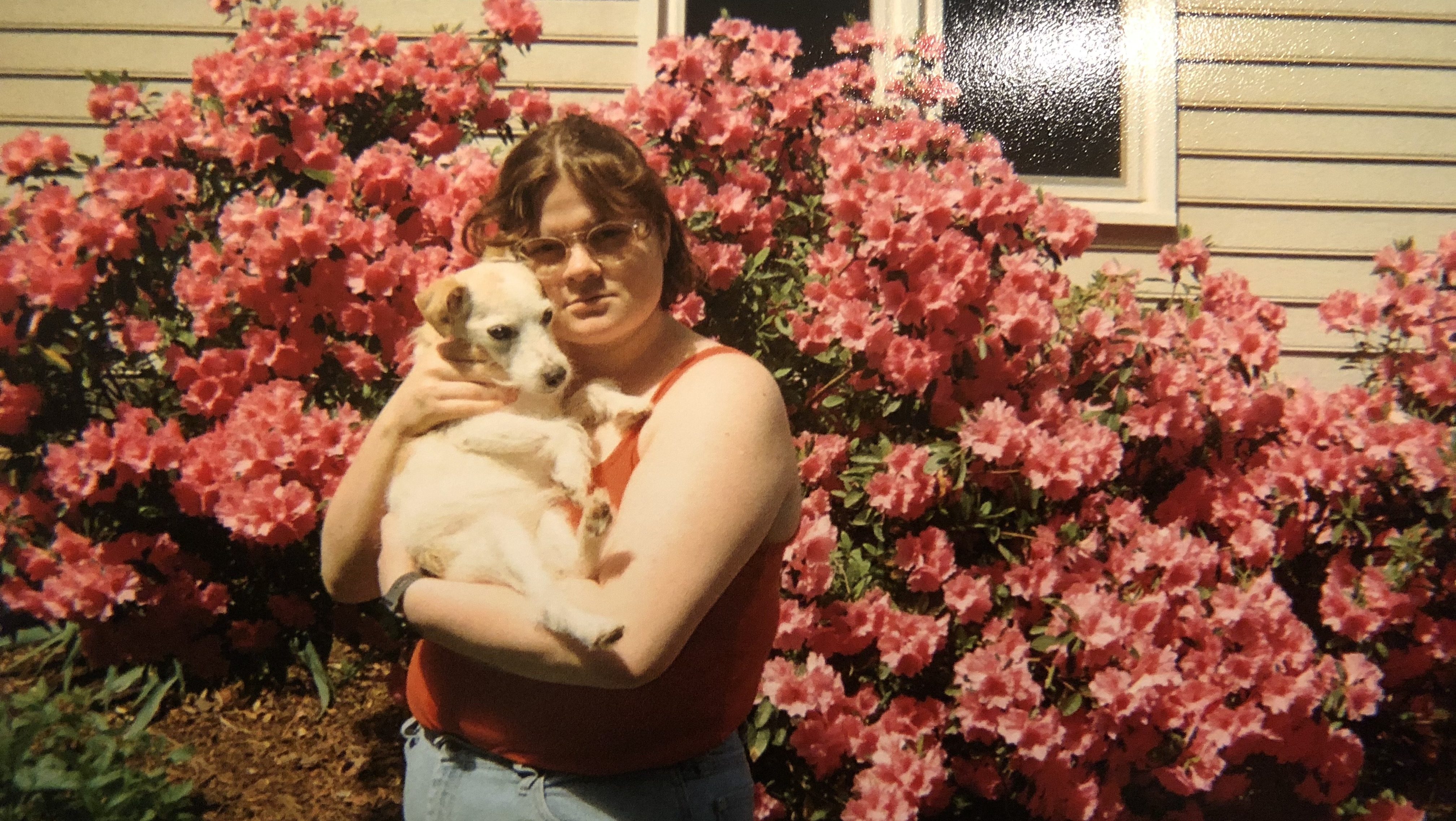
Me with my old dog Annabelle in front of an azalea bush
This summer I’ll be interning at the Charlotte Museum of History for the Save Siloam School Project, working to tell the story of one of the oldest African American schoolhouses in Mecklenburg County. I’ll be reading all sorts of books at my leisure–my first read of the summer is The God of Small Things by Arundhati Roy. And I’ll be spending plenty of time outside biking, running, and hopefully hiking at a few spots in North Carolina all the while trying not to get sunburnt!
I’m looking forward to my final year at Queens–a really bittersweet thing! I’m excited to start researching and writing for Masterworks and taking the last classes to fulfill my major and minor requirements. And I’m enthusiastic about continuing my work for the Center for Student Success as the lead tutor and, of course, the College of Arts and Sciences Blog. by Emily Iknayan
The coronavirus pandemic brought with it a sudden interest in kitchen chemistry, such as the fermentation processes involved in the making of sourdough bread and kombucha. Here at Queens, at the start of the pandemic, in-person labs were out of the question. So, Dr. Aaron Socha of the Chemistry department and his students adapted. Inspired by the Biology Department, Dr. Socha put together boxes of materials for experiments for local students to pick up or for shipping to students as far away as Texas, Puerto Rico, and Holland. For the first experiment, the boxes included the compound alum, and for the second one, they included yellow, blue, and green M&M’s.
Experiment: The burning of biodiesel
When considering how to structure the experiments, Dr. Socha had to ensure that experiments were “benign, not dangerous” and consisted of materials that were able to go down the sink and did not require the use of a fume hood. These requirements, according to Dr. Socha, were certainly a change of pace for organic students as they are “typically working with solvents that are very volatile and things that…tend to be flammable.”
Accordingly, students initially focused on a lab centered around the growing of crystals. For this at-home experiment, Dr. Socha referred back to a text written by chemists Alan Holden and Phylis Singer, Crystals and Crystal Growing, which wasgiven to him by his undergraduate advisor after his graduation. He discussed the practical applications of crystal growing in organic chemistry: “A crystal is essentially the purest form of any substance, and day after day, week after week, organic chemists run reactions and produce mixtures…Typically any quality chemical synthesis results in a pure product or a pure-enough product because you’re going to want to ascribe some properties, like melting point or its ability to act as a medicine or anything else.” The chemical compound alum was one of the materials included in the boxes students received, which they used to grow crystals at home.
The second at-home experiment dealt with yellow, blue, and green M&M’s. Its hypothesis was that green M&M’s are not just green but rather a mixture of yellow and blue pigments. In this experiment, the yellow and blue M&M’s were the controls, and the pigments were separated with a silica resin, which is “a form of polymer that allows you to physically separate different substances.” Dr Socha described the mechanics of this experiment: “You basically pack a column with the silica powder and then pour your dissolved substances over the column, and then gravity, and the interaction with the silica, being differential for each compound, allows them to physically separate in time.” Students dissolved the green M&Ms in water and extracted the pigment, poured the pigment in the column, and witnessed the colors separate into yellow and blue. The column separation was cross-checked with a plate separation, or an orthogonal test.
The IT department also helped, offering another innovation derived from the COVID-19 semester(s). They put some lab instruments on a VPN (virtual private network) so that students could observe the running of the Queens lab equipment over Zoom. These instruments included a gas chromatography mass spectrometer, the NMR machine. With the VPN, Socha said, students “can share the screen, they can click the mouse, they can run samples, they can pull up compounds in the library, they can integrate peak areas, [and] they can crunch data” with the gas chromatography mass spectometer. Students could log into the VPN and use the software to “generate their structures and use them in their lab reports.”
After the two kitchen chemistry experiments, students were finally able to get back into a physical lab at Queens, but with the necessary COVID-19 restrictions. Social distancing requirements meant fewer people in the labs. One focus of this lab work was on biodiesel, a “molecule or a group of molecules made from cooking oil” that acts as a “replacement fuel for diesel in combustion engine generators and home heating fuel.” For this experiment, the biodiesel was first made, and then the acidity as tested. Dr. Socha explained where the materials were sourced from: “We got some of the grease from Queens cafeteria to do that. We compared it to the stuff from McDonald’s and stuff from Chick-Fil-A” and interrogated who had the best grease or who was changing their cooking oil the most frequently. Also, Dr. Socha purchased some no. 2 diesel from the gas station, burned it in the lab, and found that it produced a startling amount of soot, which he compared to something that could be apprehended in a Charles Dickens novel. In contrast, biodiesel produces no soot.
Experiment: The burning of no. 2 diesel
Students conducted a similar experiment in the lab, burning a few milliliters, filling a beaker with water, measuring the temperature, and calculating the energy value. The students found that the energy value of diesel and biodiesel is quite similar. Further, students were able to consider how much soap they can make if that started with a recycled cooking oil. They then moved on to consider real-world applications of their experiment, such as the costs of using petrol diesel as opposed to biodiesel, from an environmental perspective, as well as from a public health perspective.
The in-person labs benefited from other vital personnel. Queens Chemical Safety Officer, Jack Killion, helped with the design and execution of some of the in-person labs for CHM 112. This was a valuable collaboration during a time of otherwise solitary, remote work.
Throughout these on-campus experiments, Queens science students showed their enthusiasm about attending labs and learning more about biodiesel, especially those involved with sustainability initiatives on campus.
Sometimes, as English majors, it’s difficult for us to imagine the practical application of our degrees. My friends used to joke that I was getting a “Barista” degree since I wasn’t interested in teaching. And while they meant it to be fun and games, as a rising Freshman in 2017, I found a future of pouring coffee looming in the background. But Queens makes sure to present its students with opportunities that set them up for success after graduation. And my professors in the English department have shown me that perfecting a caramel macchiato doesn’t have to be my main post-graduate plan.
One of my favorite examples of this is the South Atlantic Modern Language Association (SAMLA). The Modern Language Association (MLA) is an international organization that unites language enthusiasts from around the world; the South Atlantic Modern Language Association is an offshoot of that larger organization. Every year since 2017, Dr. Bonnie Shisko and Dr. Helen Hull of the English department have encouraged to submit abstracts to SAMLA for their undergraduate panels, going on to help students with accepted abstracts prepare their paper. With support from the College of Arts and Sciences, students and faculty have been able to travel with students to the different conference locations for a weekend of scholarship, presentation, and fun.
Students who presented at SAMLA, as featured on the Arts at Queens Facebook page.
This past November, the SAMLA conference, like many academic conferences, was held virtually. Senior English majors Nia Murat, Allison Schwai, and Aspen Payne presented papers, with subjects ranging from gender to the gothic to the treatment of time in literature.
Along with the professional development that presenting at SAMLA gives students, Dr. Shishko pointed to the amazing opportunity it provides for students to network and engage with other scholars. The conference allows them to develop their “become agile […] in terms of academic communication,” or ability to adapt their ideas to fit the setting, Dr. Shisko said. It also helps students develop their own academic agency and voice, Dr. Hull pointed out, which then pushes their scholarship forward.
“We have a good circle of communication going,” said Aspen Payne on how she heard about the opportunity, adding, “If something’s happening and your ears are open, you’ll hear about it.” Senior Allison Schwai had a similar experience, having overheard a classmate talking about her SAMLA essay. Schwai credited the genesis for her paper, “The Obvious Genders of Hidden Narrators: How Do They Matter?” with the fact that “[the English professors] do such a good job of making you think creatively.” The essay, Schwai said, sprung from a mixture of many English classes that helped her develop her ideas.
I had a similar experience, taking a paper that was four pages past the page limit and developing it into the piece that is now “Gears of Humanity: Time and Nihilism in Watchmen.” Payne, however, got her ideas from a class across the pond, saying, “I took a course in England on Freudian psychology and literature.” Her love for horror stories and literature then lead her to write “Recurring Madness: The Psychoanalytic Terror in The Haunting of Hill House.” And while the pandemic cut her study abroad experience short, just like it did mine, she was able to take her experience there and bring it back to Queens.
The pandemic presented many challenges, especially given that we had to have all our group meetings and communication over RingCentral. Plus, there wasn’t a physical conference, nor the fun academic banter we would have had on the car ride down to the venue. And the online semester was hard on both students and professors. But every step of the way, our group of students and professors supported each other After three months of hard work, on November 14, we three students and Dr. Hull all presented our papers. We also took all the feedback and support we’d gained from our meetings. “It sounds super cheesy, but my favorite part was hanging out with you guys,” Payne said. In a time when we’re all quarantined apart, I couldn’t agree more.
After nearly four years of success, Dr. Hull and Dr. Shishko are now taking their SAMLA project to a new level. Now, the Queens Literary Studies Undergraduate Research Program (QLIT) has a home in the Jim Rogers Summer Institute for Research and Creative Work. These professors are going beyond SAMLA to help students develop work for publication, other conferences, and even civic engagement projects. They’re even offering students a stipend for their work. Thanks to the work done by Dr. Shishko, Dr. Hull, the College of Arts and Sciences, the English department, CAS, and Leslie Marsicano, Director, Preyer Honors Programs & Initiatives, a whole new world of English scholarship is about to open for a new generation of English students. Dr. Hull described why this new world is so important for students, professors, and the humanities as a whole: “Getting to work with students, to see them develop those particulars and see them push back, or add to the conversation: it’s about the value of the knowledge we create in the humanities.”
While these students have presented essays in literature, another student has achieved excellence by publishing an essay in professional writing and rhetoric. Senior Lanie Walsh, supported by Professor Jennifer Daniel, published an essay that grew out of her work as a Writing Center tutor. In the center and in the accompanying Composition Theory Practicum course, students develop their writing skills both inside and outside of the classroom.
“A lot of people think of the Writing Center as this place you come to get your paper fixed and then go on your merry way,” said Professor Daniel. “That’s not actually what we do.” While tutors do aid students in developing their writing for an academic setting, they also help students develop their understanding of writing as an art. Tutors take into consideration their tutees’ previous history in writing courses, their confidence in writing and with writing in English, as well as what it means to write at the collegiate level. Each student comes into college with a “beautiful array of different experiences,” according to Professor Daniel, so each student has different tutoring needs.
To prepare them, all writing tutors take Composition Theory Practicum, a course required for professional writing and rhetoric majors as well. Professor Daniel leads this course, pushing students to reconsider their preconceived notions of gender, race, subject positionalities, and the rhetoric that surrounds writing. This course culminates in a final essay in which students write about an experience in which they were marginalized, then relate that back to tutoring and/or the topics they uncovered in class. This essay not only encourages critical thinking, but it also acted as the genesis for Lanie Walsh to travel beyond the bounds of the Writing Center, in the form of a published essay. Her essay focused on an experience before her time at Queens.
“I decided to apply to the Naval Academy,” she says, “and in that instance, being a woman puts me at a large minority. And they looked at my private, all-girls high school and said ‘yeah right.'” Walsh went on to describe how the Congress review board – a requirement, as you have to get an endorsement from your Congressman to enter the Naval Academy – was entirely white and male. They tested her harshly, talking quotes from her letters of recommendations out of context to paint her in an unfavorable light. By the end, Walsh was left to deal with the weight of their criticism and biased rejection.
But, where they attempted to break her down, Walsh rose above their criticism. She said, “I can take this experience and use it to relate to a student that feels like a fish out of water in a college English class.” After adapting this experience to Composition Theory Practicum, she saw another chance to expand on her experience when Professor Daniel mentioned a journal that published the work of peer tutors, specifically for peer tutors, The Dangling Modifier. Walsh jumped on the opportunity, working closely with Professor Daniel to prepare her piece for publication.
Much like the SAMLA experience, the world of publishing is a distant cousin to the classroom paper. “It’s a different rhetorical situation,” said Daniel, one that comes with the knowledge that your professors’ eyes won’t be the only ones to grace your ideas.
Adapting to a new rhetorical environment, on top of the two-month time frame and overall 2020-ness of it all, proved a challenge. But with the help of Professor Daniel and her own determination, Walsh produced a paper, “Bracing for the Contact…Zone,” that now sits proudly on The Dangling Modifier’s website. And Walsh said the paper hasn’t stopped there. She’s adapted it yet again for graduate school programs and internships at venues like the Smithsonian. “The essay has lived far beyond this publication” she said, helping her inform and carry out her plans once she graduates in May.
And while adapting their work at the writing center has been a challenge in the face of this pandemic, the synergy between students, their peers, and faculty can’t be dampened by distance. In these two CAS success stories, we see examples of excellence expanding beyond the bounds of campus, as the Queens community stands together and continues to do what they do best: work towards improving their futures and the future of their field.
When Queens’ semester went virtual, that didn’t stop some students from helping local non-profits. Last fall, seniors in the Graphic Design Capstone, led by Prof. Melissa Gamez of the Art, Design, and Music department, aided their community by sharing their creativity and the skills they’d been honing over the course of their New Media Design major.
By design, students chose non-profits that would not otherwise have the budget to obtain promotional materials. The students helped produce at least three “deliverables,” such as flyers, social media posts, and brochures. Prof. Gamez stressed the importance of community work: “For me, it’s always how I’ve run my business, and as a human being—you’ve got to take care of your community.”
Prof. Gamez said, “It was so challenging with us all being online. The first thing students learned about was communication.” She then went on to explain that these organizations work 24/7 on their own schedule, and they have only a set amount of time to commit to keeping up with contacts. Therefore, the students had to be clever about getting in touch with their non-profit.
Capstone is an opportunity for Queens students to round off their education through study, research, or practice in their fields. For New Media Design students, a portfolio is constructed of their work in the first half of the Capstone. This year, during the pandemic, the department chose a specific form of outreach that would give students experience and practice.
Having a personal stake in the non-profit’s mission wasn’t necessary, but to many of the students, it was vital in choosing who they wanted to work with. Working with the non-profits would benefit them by giving them the experience they needed with professional mock-ups, branding, and communication with clients that is usually not included in the program.
This approach gave them the hands-on experience they needed to practice dealing with clients, as well as giving them access to a portfolio and contacts for the future. The Capstone allowed them to make dealings with a client and specify what they wanted, while also allowing them to get practice in and produce pieces for the class. Furthermore, they had to strategize on how to work on their own schedule to get their deliverables done, while also maintaining contact with the client.
Sarah Jane Atkinson, a senior New Media Design major, chose to work with Kangaroo Kids, an organization that aids children with chronic illnesses. Kangaroo Kids construct medical binders called “The Pouch” that hold supporting materials needed by the parents like charts, appointments dates, and medical records. Sarah says she picked Kangaroo Kids because of a personal connection, “I chose to work with them as I believe their impact on the chronic disease community has been amazing. In addition, I also have a chronic disease, and their services would have been a great help when I was young.”
Having a personal stake in the matter and mission of the non-profit made working with the nonprofit that much more rewarding, Sarah said. Creating personalized materials that helped the non-profit with outreach and communication provided a unique experience, especially during the pandemic. She related her passion and interest in Kangaroo Kids to her own chronic illness, and feeling a responsibility to give back to her community based on her own experiences.
Sarah also recognized the importance of community in the non-profit setting, “Nonprofits have one thing in mind: helping relieve the issue they have chosen to work with. These issues can range from diseases to climate change to much more. All these issues have one thing in common, the fact that they affect everyone in the community. Without nonprofits there would be a disconnect in the communities needs and solutions to those needs.”
Courtesy of Kangarookidsclt.org
New Media Design senior Sydney Schwai worked with “Bright Stars Beyond the School Day,” an after-school program geared toward closing the achievement gap of grades K through 5. Sydney explained why she chose an after school program, “I was interested in Education, and kind of bettering those opportunities…”. She focused on rebranding the combination of their after-school program and the academic program as well.
She elaborated on this unique experience for graduating design majors: “I was communicating with people that didn’t understand the same design jargon… so I was really trying to make myself understood [and] assisting their vision.” She went on to say that surpassing the difficulty in client-based communication gave her the skills she needed to be able to focus on design efficiency as well as customer service.
From the Bright Stars Beyond the School Day website
Reflecting on working with a non-profit and her future interest in working with similar clients, Sydney said, “Personally I wasn’t very interested in branding, and that was such a large part of my project, but it was really interesting working with something outside of what I was interested in.” She said that it was a good opportunity in the capstone to be able to connect with the community and bring their work outside of Queens: “It was interesting because we had never really had an outreach in the program before, it had mostly been internal.”
Senior Michael Kearns, a New Media Design major, described his experience: “When choosing a nonprofit I wanted to work with an organization that I can give back to my people [while] doing all the research that was available I narrowed it down to the Boys To Men Foundation. The nonprofit focuses on helping young boys that don’t have a male role model in life, which they mentor them to all the way to 18 years old. Their two primary goals are to give them life lessons of what a young adolescent male should have and prepare them for the actual world.”
He went on to say that enriching the community was a priority, and that he believed it had taught him a lot about both giving back and client work.
These three students all confirmed that the community outreach was good exposure for client based practices, as well as an opportunity for them to give back to their community during such a hard time, the pandemic.
In the early months of the pandemic, Dr. Bob Whalen and Dr. Sarah Griffith of the History department each worked with two History majors to take a plunge into the past.
Dr. Whalen’s research assistants, senior History majors Molly Caskey and Lanie Walsh, assisted him in developing the bibliography for his book about Casablanca, which he identified as “the world’s greatest movie,” and its connections to prominent thinkers of the time.
Dr. Griffith’s research assistants, recent History graduate Ali Forrest and History major Ella Van Troba, helped her explore the relationships of Japanese women living in the United States and American Christian women in in the 1920s, especially the effects that anti-Japanese sentiment had on women, on the psyche of their children, and on U.S.-Japan relations. Her research will lead to a conference paper and publication.
These two student-faculty collaborations were made possible by the Preyer History Fellow research assistantships. In the fall of 2019, the History department established research assistantships, enabling students to gain insight into what professional historians do.
Dr. Whalen described the professors in the History department as “active scholars,” and with their scholarship, the professors invite students to partake in research outside of the classroom with the research assistantships. Caskey and Walsh were not doing the typical archival work of historians as they searched through all sorts of not necessarily scholarly sources (IndieWire being one example) to find more about the multitude of perspectives on Casablanca.
When Dr. Whalen elaborated on his research interests, he said: “What I’m interested in is the way in which a film can raise wider questions about friendship, about loyalty, about war and peace, and so on. What I’m trying to do is engage three other people who lived at the time whose lives sort of parallel what was going on, people like Hannah Arendt, who was a German-Jewish philosopher, the French writer Albert Camus, who was in the French resistance, [and] the German pastor Dietrich Bonhoeffer.” Whalen’s idea was “to bring these three real-life people, who experienced that era, into a discussion about stuff raised by the movie. So, it’s an effort to take a pop culture thing, a movie, and see if there are any wider ramifications to what the film tells us about life not only in the 40s, but life in general.” He said that the work is still in process and he is hopeful to have the first draft of the manuscript completed by the fall.
The idea for Dr. Griffith’s research came about five years ago when she was working on her first book. Dr. Griffith said: “I had seen some oral histories of these Japanese women living in the United States in the 1920s. And I wasn’t researching Japanese women at the time, but I was really intrigued by what they were saying because they seemed progressive, for lack of a better word. So, these women were very well-versed and outspoken, which was just uncommon, you know, for many women but especially Japanese immigrant women at the time in the 1920s. And so, I was intrigued by them, so I kind of tucked those away for another day when I was done with the book, and so I’ve been kind of researching just the basics of those Japanese women’s lives now for about four years. And so, from that research, I learned that they were all very good friends and allies with American Christian women, and so that was kind of the common bond between these women is that they were all involved in either Christian churches or international organizations, like the YWCA.”
By the time Dr. Griffith had all of this information gathered, she was able to access different archives in Japan. When she was a Fulbright Scholar in Japan in the fall of 2019, she learned more about three Japanese Christian women, their travels to and from the United States and Japan, and their relationships with American women. When she returned to the United States in February 2020, she had enough material from the archives in the United States and Japan to produce what is now a conference paper for the American Historical Association Annual Conference, the biggest conference for U.S historians, which she will be presenting with one Japanese scholar and three U.S.-based scholars in May, 2021. After Dr. Griffith receives feedback from the conference, she will revise the article to be published in the Japanese Journal of American Studies.
Dr. Griffith explained how her research assistants, history majors Ali Forrest and Ella Van Troba “were working on processing essentially and critically analyzing the US archives” from California State University, Northridge, which “were mostly publications of the YWCA and then a handful of meeting minutes.” Their goals as research assistants were to explore the power dynamics between the American chapters of the YWCA and the “foreign” chapters and attempt to figure out to what extent Japanese women had agency in this organization. “The research assistantships are truly a fruitful endeavor for all parties involved,” stated Dr. Griffith, adding, “you know, it’s great for us because we’re able to do collaboration that betters our work, but it’s also really, I think, valuable for the students because they’re able to then put that on their CVs.” One particularly remarkable aspect of the research assistantships is the fact Dr. Griffith’s research assistants “are going to be acknowledged as co-authors” upon publication.” She said how student-driven the History department is: “We’re really attuned to saying, you know, our students are our main focus, which has led the department to look for ways to consistently expand and improve, and the research assistantships are just one example of this.”
Overall, through the research assistantships, students were able to work in a collaborative setting to practice contextualizing various types of sources that helped them prepare for Masterworks, the capstone course for History majors, as well as gain insight into what it means to engage in research outside of the classroom. Lanie Walsh expressed how she “gained an appreciation for older movies” and “exposure to a new culture.” She touched on the contentment she got from being able to contribute to and witness Dr. Whalen’s composition process and her excitement about the book’s future publication: “Getting to see the skills that we practiced be put into use in this practical thing that’s going to manifest itself in this physical book, that’ll be really exciting.” In Molly Caskey’s work with Dr. Whalen, she “learned quite a bit about how people wrote about their experiences during the war and how others interpret them years later, given a postwar and new context.” She also commented on how getting firsthand experience with Dr. Whalen’s manuscript development readied her for the process of writing a 20-page paper for Masterworks.
As recent history graduate Ali Forrest reflected on her experience as a research assistant for Dr. Griffith, she explained that the opportunity, “empowered me and my fellow research assistants to practice our skills in a professional environment.” Each research assistant had a similar sentiment, including Ella Van Troba, who declared: “I really think that the History department and Dr. Griffith have done a really good job at making sure that we have all the opportunities that we can in undergrad in order to be successful after we graduate.” She elaborated on the particular benefits of being a History major at Queens: “The professors in the History department are all really great, and it’s so small that I have a personal relationship with every one of them. And so, it is really nice that they push out these opportunities and encourage students to do a research assistantship.”
Since 2015, students in the History department have been afforded incredible opportunities by the Preyer History Fellow program, named after the late Dr. Norris Preyer, thanks to the immensely generous financial assistance by the Preyer family. The Preyer History Fellow has allowed for scholarships for History majors, support for students on their JBIPs or semesters abroad, Capstone student research awards, and research assistantships.
About her research in self-forgiveness, Dr. Karen Neal says: “Forgiveness is a process.” The validity of that statement is most apparent in the research study Dr. Neal has been conducting over the past five years. That’s because it focuses on the person we least think of forgiving: ourselves. Her study, which follows its primarily university-based subjects through nine modules, approaches self-forgiveness holistically: it includes topics such as psychology, psychiatry, and religion. Dr. Neal, of the Psychology Department, has been working with Dr. Lauren Toussaint of Luther College, one of the leading voices in the psychology of self-forgiveness. Now, after five years of dedication and diligence, she and her research partner are looking toward publication.
After writing her dissertation on perceptions of parenting styles’ effects on children’s forgiveness, Dr. Neal knew she wanted to continue digging into the science of forgiveness. This study is a manifestation of that desire, as Dr. Toussaint allowed her to join his research in the efficacy of self-forgiveness. At the beginning of each module, subjects are given a pre-course assessment to better measure their development, from the beginning to the end of the course. According to Dr. Neal, the majority of subjects reported significant improvements in self-efficacy, dealing with guilt, self-loathing, and resentment, as well as promoting self-acceptance, all qualities necessary for positive self-worth. Neal says these results were also generally linked to positive living and good health. Although she would “never tell you ‘you have to forgive,” her research gives subjects the tools they need to start the process of forgiveness.
And while the study has been a focus for the past five years, her work doesn’t end there. Professor Neal has been a member of the Queens Psychology department for 15 years, and for 13 of those years she’s offered PSY 351 Forgiveness: Theory, Research, and Practice. The course allows students to explore similar topics in forgiveness. The flexible nature of Queens’ courses allowed Dr. Neal the freedom she craved to put together a course for all university students that gave them the tools necessary for positive self-affirmation. The course is often offered as an evening course, allowing students to lead class discussion and present research on forgiveness to a close community. Students have had just as positive a reaction to the course as subjects in the study, going so far as to create an Instagram page to further promote what they’ve learned.
“Queens was a bit of a career goal for me,” Dr. Neal says, primarily because our liberal arts approach allows students an opportunity that is rare at other institutions, especially at the undergraduate level. In effect, Queens’ liberal arts tradition has said “Yes And” to her work in forgiveness.
In spite of the pandemic, Dr. Neal continues her work in 2021, connecting with her students and promoting positive mental health practices in a time when we need them most. In fact, the way her course is organized allows for a somewhat easy transition in our new COVID-era of learning, since it’s basically a hybrid already. And though the course lacks the same synergy created from in-person connections, her students have still been engaged and dedicated to growing through the course. Her research has always focused on positive development in psychology. And in this study, we see her fostering that same positivity at Queens.
Recently, Dr. Eric Mullis of the Philosophy and Interfaith department earned a Fulbright Scholarship to teach in the dance program at Taiwan National University in TaiPei. Dr. Mullis will focus his course on the philosophy of the body and self when intertwined with dance and technology. In the class he will ask questions about the philosophy of body and mind in dance, and how various technologies add or take away from that. He and his students will look at technologies such as prosthetics, holographic imaging, robotics, and how they influence contemporary dance.
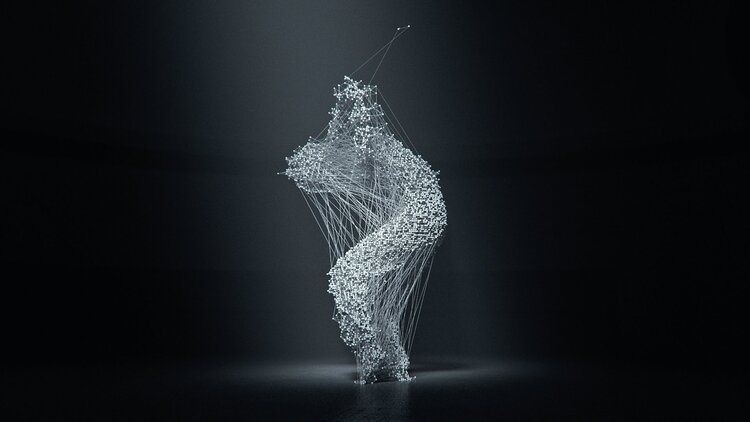
Dr. Mullis’s education is eclectic indeed, with degrees in both dance and philosophy, and as seen in his book, Pragmatist Philosophy and Dance: Dance Research in the American South. He also has a variety of performances on his website that display his dance research, as well as his current work. A figure of dance and technology, from Dr. Mullis’s website.
Dr. Mullis says that the Fulbright scholarship gives him an opportunity to represent Queens and teach content that he is passionate about doing at other universities and sharing pedagogies with them. He, along with other professors, will focus on not only dance, but will also have the opportunity to incorporate philosophical ideas as well. Furthermore, in the link to the course, he offers some guiding questions about the intersections of philosophy, dance, and technology:
“What do technologies such as automata, prosthetics, robots, motion capture, and interactive digital environments reveal about embodied experience? How have dance artists considered those questions? How has contemporary dance technique been shaped by technology? How do cultural beliefs about technology factor into the reception of dance technology? What conceptual tools can be useful for the dance artist working with innovative technologies? This course uses an interdisciplinary methodology—including history, theory, and studio practice—to answer these questions”
In Mullis’s words, the Fulbright Scholarship is about more than just traveling abroad and gaining new experiences: it also entails international cooperation and collaboration, as well as an expansion in knowledge and discourse. For example, with his opportunities to share his pedagogies and research with other faculty at Taiwan University, he is able to reach students across areas of study. He really looks forward to the cooperative part of the time in Taiwan, which he feels will give him a well-rounded experience and a new perspective on both dance and philosophy. He hopes for successful cooperation and a fruitful time abroad. Additional photos and videos of his work may be viewed on his website, linked here.
Debating with Ethics
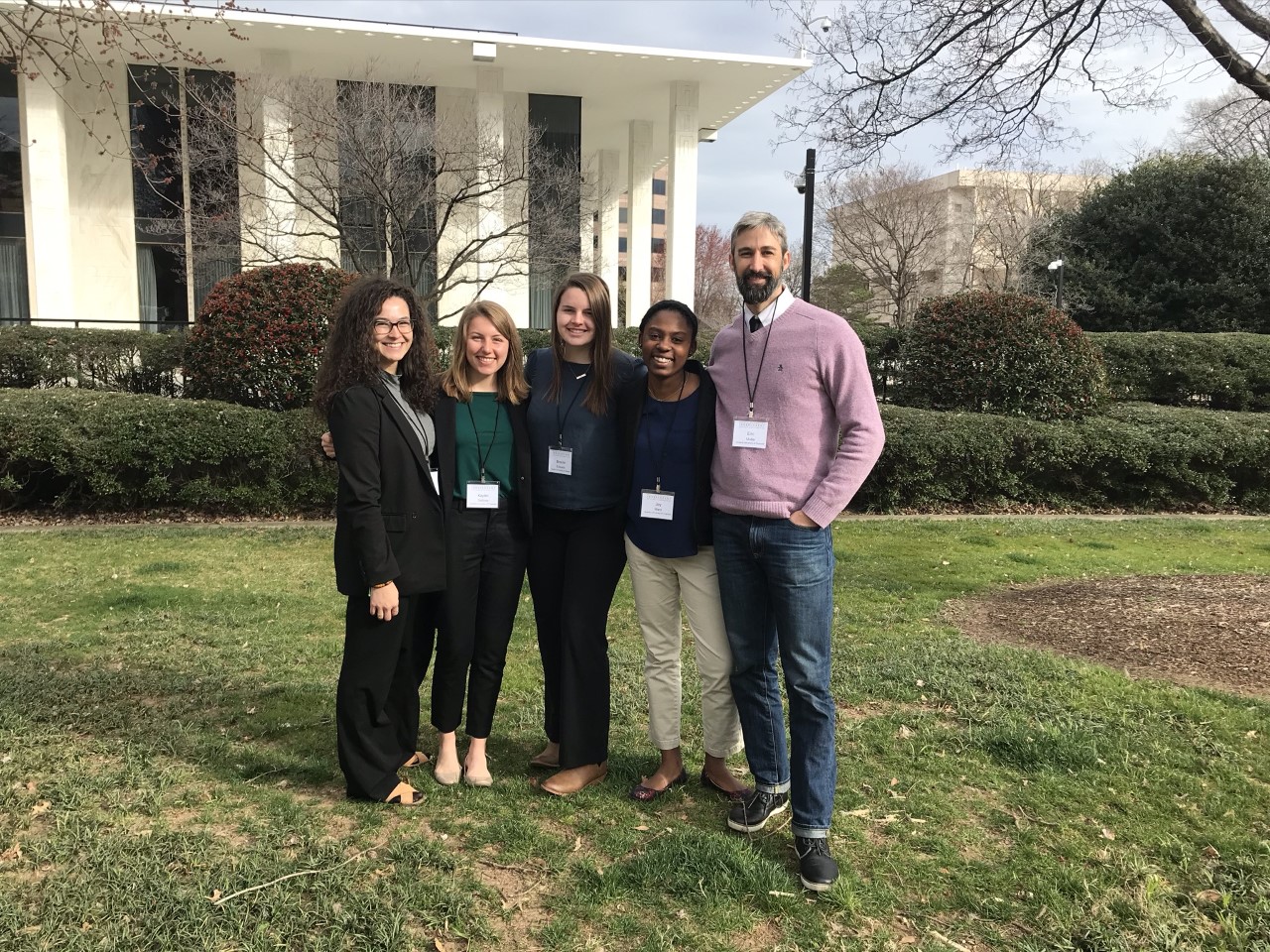
Students Tasha Groburg, Kaylor DeBrew, Brooke Edwards, Joy Ward, and Dr. Mullis at the Ethics Bowl.
Every year, Dr. Mullis and the Queens Ethics Bowl team travels to Raleigh to compete against other universities. Students work with Mullis, the team’s academic advisor, as they develop critical thinking skills, decision-making, and argumentative skills that they can then transfer to their other studies. This year, students Kayler Debrew, Joseph Hines, Joy Ward, Emely Barahona, and Tasha Groburg comprised Queens’ most successful team so far. They won three out of four rounds, on their way to becoming semifinalists.
Students on the Ethics Bowl team work with Dr. Mullis to prep these cases by engaging in various discourses throughout the semester to practice. Prepping the cases is only the first part, but it takes up an important majority of the team’s time. Mullis explains that prepping through the year is what makes them geared for success. The Ethics Bowl often incorporates current events into their cases, making it a great way to flex and develop these skills, as well as exercise them effectively. The Ethics Bowl is designed to encourage deep thinking and foster learning, while giving its competitors a taste of real-world examples. The judges and overseers are former lawyers, judges, legislators and representatives who have been working with ethics and tough decisions their whole lives.
The Queens Ethics Bowl team is not only made up of Philosophy majors. The team also consists of Environmental Science and Political Science majors, as well as students on various tracks such as Dental, Pre-Med, and Pre-Law. Such a range of majors and tracks just goes to show just how diverse a team can be while also maintaining the strength needed to push through the various levels of competition.
Senior Emely Barahona says that so much more goes into it than what scratched the surface: “Everyone on our team had a different skill. For example, Kayler and Joy were biology/sustainability majors so they would take on the science side while Joe, Tasha, and I were on the philosophical theory application side. We would practice each meeting, and we constantly gave each other feedback and practiced how to come up with what we were going to say under timed pressure”.
Barahona says that she has learned a lot from her time competing but ultimately, “my favorite part was being able to be the first Queens team to win three out of four rounds. It was such a huge accomplishment and something exciting we got to bring back to campus. I also loved going to Raleigh and having the reception in the museum of science and natural history! It was so cool!”
Queens is proud and privileged to have a semifinalist Ethics Bowl team! Congratulations to the members and Dr. Mullis, and may there be many more to come!
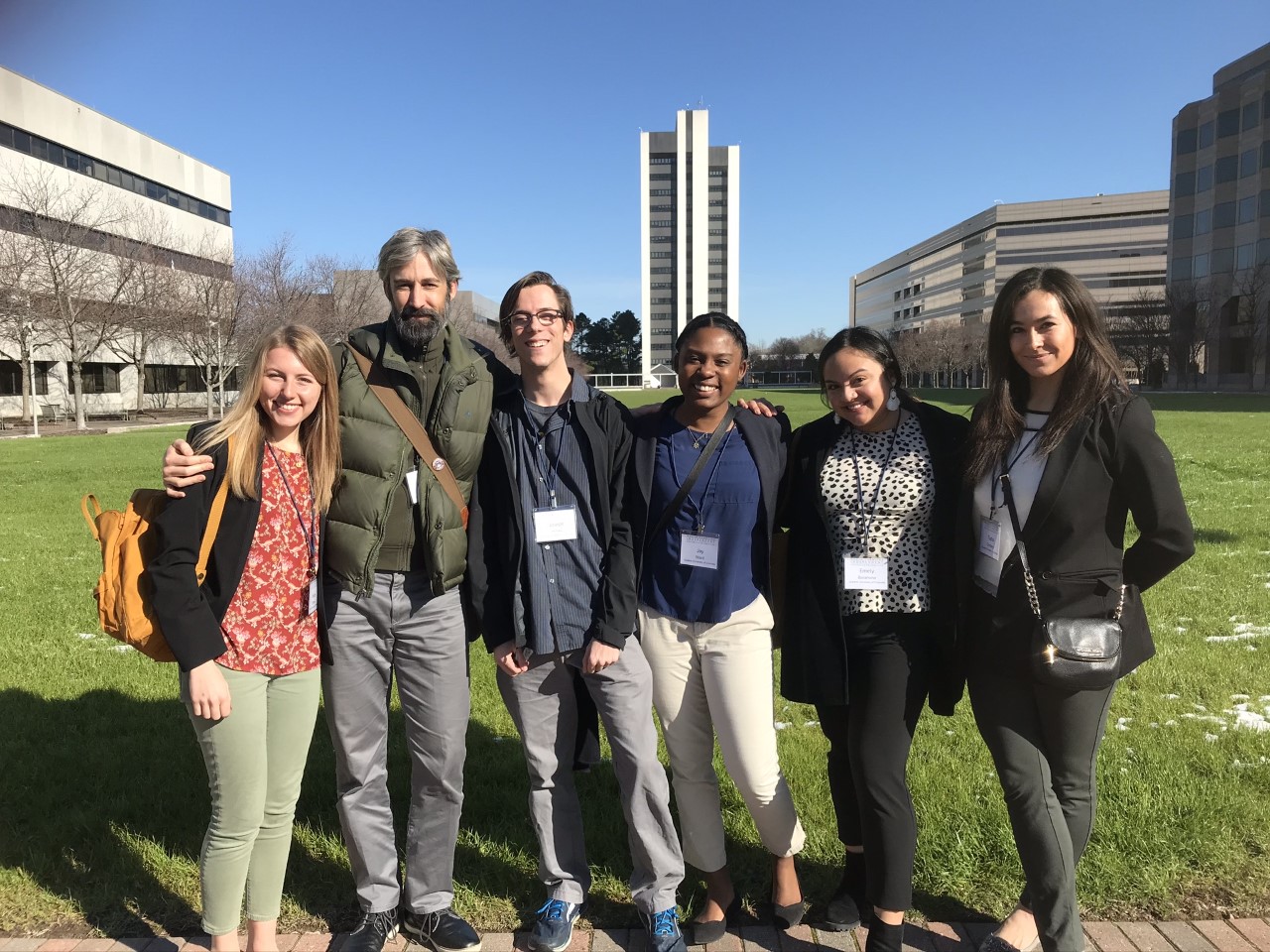
Students Kayler Debrew, Joseph Hines, Joy Ward, Emely Barahona, and Tasha Groburg with Dr. Mullis in Raleigh
Last summer, the inaugural Jim Rogers Summer Institute swept in a new kind of student-faculty collaboration. The results were impressive: a written adaptation of a video game, a social-justice documentary, and a legal research survey. With the Institute’s generosity and vision, three pairs of students and faculty from the Colleges of Arts and Sciences and the Knight School of Communication embarked on exciting research projects and creative endeavors. Jacenta Wallingford collaborated with Prof. Julie Funderburk (English department) on the adaptation, Pascalle Williams worked with Prof. Shawn Bowers (English department) on the documentary, and Emily Iknayan, the writer of this post, teamed up with Dr. Andrea McCrary (English department) on the research project.
The Jim Rogers Summer Institute “provides students immersive independent research experiences of 6 to 12 weeks on the Queens University of Charlotte campus in collaboration with or under the supervision of Queens faculty members.”
Jacenta Wallingford, a senior majoring in Creative Writing and minoring in Professional Writing and Rhetoric, worked with Professor Julie Funderburk on an adaptation of adventure game What Remains of Edith Finch. Through the Institute, Wallingford was able to commence the experimental work–amalgamating poetry and prose to adapt a video game–she had not yet been able to produce in a creative writing classroom. Wallingford discussed her experience of engaging in a collaborative creative writing process with Professor Funderburk: “The mentorship part on top of the conversing about what short stories and what poems would best work to exemplify what I’m trying to do like style wise. It made me feel like that’s what writers actually do when it comes to collaborating on pieces, on work, and it helped me understand that creative writing can be collaborative. It doesn’t have to be solitary.”
Professor Funderburk described her role in the project: “The whole project was her, something she conceived of, and so really being able to work more as a guide than anything else to help her get where she was trying to go, it was an exciting place to be as a faculty member.” She elaborated on her experience working with Jacenta: “Another joy for me in working with her on this is that it was project driven and process driven and part of that is because of Jacenta’s mindset. She’s an artist, she’s a writer, and she wants to focus on that. But to be free: and I mean that to be free of grading, and to just be able to embark on process.” Wallingford’s adaptation will be about the size of a novella by the time the work is finished, but the end result is not as important as the process of the project because her goals were process-oriented.
Pascale Williams, a senior majoring in Multimedia Storytelling with a concentration in Digital Media Production, collaborated with Professor Shawn Bowers to explore how predominantly white institutions, particularly Queens, engage with students of color by way of a documentary. The idea derived from a 200-level QLC, a creative writing class about place and identity, taught by Professor Bowers that was made up of mostly international students, in which Pascale was a student. One question,“What do you want your white professor to know about how you show up mentally, physically, otherwise in a classroom?,” served as a jumping-off point for their project.
Pascale Williams filming part of her creative project
Professor Bowers described Williams as a “creative genius,” stating “I think she sees things cinematically like she just, you know, approaches the world that way,” which made a documentary an appropriate medium for the content of their project. Williams explained her goal for the project: “to tell a story that educates and empowers, I think, is my goal, a story that empowers students, educates students, empowers professors, educates professors, and also just maybe promotes some change.” Their collaboration was a critical component of their project as Williams illuminated that Professor Bowers “has been a champion of me as a student since I was a sophomore, which is when I met her in class, and her belief in me as a student and as a person has helped us, I think, propel this whole thing forward. So, I’m really, really grateful for her support and her collaboration.”
As a mentor, Professor Bowers expressed appreciation for the Jim Rogers Summer Institute allowing students to see themselves as “peers and co-collaborators and colleagues” of their professors. She emphasized the “brilliance” of her students and the importance of student-faculty collaboration: “I think it’s important for faculty and students to collaborate together. I think we faculty stand a lot to learn from our students, and I think that there’s something to be said for a relationship that puts students and faculty sort of on the same level, that hierarchy doesn’t necessarily always exist.” Together, Pascale and Professor Bowers have created work that encourages their audience to be agents of change, to interrogate what a classroom is and how it can be transformed.
S. T. E. P. Program logo. Courtesy of Mecklenburg County Government Website
As a Professional Writing and Rhetoric and History double-major, I also had the opportunity to participate in the Jim Rogers Summer Institute. I collaborated with Dr. Andrea McCrary to research the structure and functioning of Mecklenburg County’s Supervision, Treatment, Education, and Prevention (S. T. E. P.) Program and how participants in this program see themselves. We were lucky that our research was not postponed by the pandemic because we were able to conduct our background readings, court observations, ethnographic work, interviews, and writing process virtually. Dr. McCrary appreciated how we were able to engage in “a genuinely collaborative process and not a sort of hierarchical process,” which I agreed with as the Institute allowed me to not only see myself as a student but also as a researcher. My work with Dr. McCrary was incredibly enriching as she taught me how to go about being a researcher and an equal collaborator throughout the process as we delved into a project that truly excited us.
Dr. McCrary construed the importance of Queens having programs like the Jim Rogers Summer Institute: “I think that finding ways to provide resources to people who have projects in mind that go beyond the bounds of the academic year or that go beyond the bounds of a particular classroom really demonstrates an institution’s commitment to developing both working relationships between students and faculty, but also to helping students and faculty develop robust research projects.” Because of the Institute’s support, I am so thankful that Queens validated my scholarly interests by allowing me to participate in this program.
The results of our creative and research projects are intriguing and will be available to the Queens community. If you are interested in hearing and viewing these projects from the initial Jim Rogers Summer Institute, we will present them at Marking Excellence on 23 April.
Spotlighting the Queens University of Charlotte CAS Success Blog staff and what they are looking forward to in 2021!
I’m Izzy Harvey, a Creative Writing major, with a double minor in Psychology and Professional Writing and Rhetoric. I’m also a junior and a Presidential Scholar. I’m from a small town in Georgia called Sharpsburg, just southwest of Atlanta, and I live in Charlotte for the school year.
This past year, Queens has supported me as a student by allowing us to continue school safely online, as well as providing assistance for my health safety as a student. Our Health and Wellness Center goes above and beyond for students, so much so that they helped me out so much during the pandemic. My professors have been very gracious and allowing of extensions and flexibility, which I am very grateful for. Something I am looking forward to in 2021 is moving into a new house and my brother’s wedding. I am also looking forward to rejoining on campus and seeing professors! Have a happy New Year! Izzy Harvey
Queens has supported me in numerous ways this year, one example being my professors asking how each student was doing before our synchronous class sessions. These acts were small but nonetheless incredibly meaningful. Additionally, I was glad I was able to continue my work in the Writing Center as a Senior Tutor so that I could support students in their writing process during this unusually difficult semester. In 2021, I am looking forward to completing my Professional Writing and Rhetoric Capstone. I’m hoping that the books I read over the break will help me narrow in on a topic. My first winter break read will be A Little Life by Hanya Yanagihara. For the new year, I plan on reading more critical theory, watching a lot of movies on Criterion, learning how to make rugs, and searching for a summer internship. Emily Iknayan
Hi! Nia Murat here, and I’m a senior double majoring in Creative Writing and Literature as well as being a part of the Queens University Honors Program. Like Izzy, I’ve had the pleasure of being a Presidential Scholar. I’m originally from Portland, Oregon and have been attending school remotely from Vancouver, Washington.
Queens has been immensely supportive this year, allowing me to continue learning remotely and giving my all the tools I need to do that from the other side of the country. Many of my professors have reached out to me to ensure my health and safety, even those I didn’t have classes with. Even with a pandemic scattering us all over the country, people at Queens still found ways of strengthening the the bonds forged in our tight knit community. In a year when isolation and separation were paramount, the support from my classmates and professors at Queens was immeasurably important.
In 2021, I look forward to finishing my Capstones, in Prose as well as Professional Writing and Rhetoric, and going on to graduate from Queens. It will be bittersweet, leaving Queens and starting my journey outside the academic sphere, but I look forward to the start of a new journey. I’m also looking forward to having the opportunity to read and write some poetry, maybe even submit some work for publication! Nia Murat
As we continue to quarantine, we’ve all had to adapt to this new virtual world in a variety of ways. Yet the pandemic challenge hasn’t stopped the Biology department at Queens from continuing their work in the Charlotte community, as they pivot in these unprecedented times.
We want to highlight the work of two distinct groups of students and faculty. Students Irene Kuriakose and Jackie Kincaid have had an eventful semester working with Dr. Susan Rucker and Dr. Zahra Bahrani-Mostafavi in the Health Care Justice Student chapter. Also, Senior Madison Jays, along with Dr. Scott Weir, have found inventive ways to work on her capstone project. In the following two stories, they show how they’ve adapted–to thrive in our new virtual world.
The Health Care Student Justice chapter was started nearly three years ago at Queens and is now led by the current President Irene Kuriakose, Jackie Kincaid, and faculty advisors Susan Rucker and Zahra Bahrani-Mostafavi. Queens’ Health Care Justice (HCJ) chapter is a student chapter of HCJ NC and Physicians for a National Health Program, often partnering with the sister organization at UNCC. Before the onset of the pandemic, they hosted a wide variety of in-person events to promote education and advocacy in the Charlotte area, often partnering with UNCC, HCJ NC, Physicians for a National Health Program, and practicing physicians. And with the health care crisis present in our country right now, they haven’t let the pandemic beat them down, thanks to their fantastic leadership.
Irene, a Pre-Med Biology major with a minor in Spanish, was inspired to join the organization after they hosted a showing of the film “FIX IT – Healthcare At The Tipping Point,” a documentary detailing the injustice and inequality present in the American health care system. From there, she started going to more events and engaging in the organization on a leadership level, as she felt called to this organization’s mission. Once the last wave of leadership graduated, Irene was ready to step up and continue leading the organization as it strove to continue fighting for equal and affordable health care.
Under her leadership and guidance of Dr. Rucker and Dr. Zahra Bahrani-Mostafavi, they’ve managed to keep events going via Ring Central and are even planning more opportunities in the future. In November, they had an event in partnership with the Greater Charlotte Health Care Executives group. This forum was with one of the nation’s leading health care executives, Don Berwick, and was concerned with racial and ethnic disparities in health care services. They’ve also hosted texting parties to inform voters about the health care plans of the politicians in the state, fun events like trivia nights, and a video campaign in partnership with UNCC that highlighted testimonies of those who have faced challenges with the health care system.
And according to Irene, there’s only more to come. As a small chapter in a larger organization, membership in the Health Care Justice chapter allows students interested in medicine at every level to engage with the industry, learn from practicing or retired physicians, and network before they’ve even finished their bachelor’s degree. Irene, with the help of Dr. Rucker and Dr. Bahrani-Mostafavi, plans to create even more opportunities in the future – maybe even partnering with “Pfeiffer and Johnson C. Smith to get even more students involved.”
In the Health Care Justice chapter at Queens, we see the very essence of our motto here as they forge through the fires of a global pandemic to promote advocacy, education, and opportunity: “Not to be served, but to serve.”
***
In addition to health care advocacy, the Biology department has adopted some fresh approaches to help students continue their capstones. Senior Madison Jayes has set her sights on a different way of serving the community. When Dr. Scott Weir approached the senior with an idea for her Capstone project, her first question was: “Do I get to wear one of the beekeeper suits?”
As a Biology major with a minor in Sustainable Science, Madison knew she wanted to work with live resources and incorporate her interest in sustainability. So when Dr. Weir caught wind of an opportunity to collaborate with Discovery Place, a Charlotte science museum, to survey bee populations in urban environments, he knew Madison would be a perfect fit. Before the onset of the pandemic, Madison was positioned to study bees up close and personal with Discovery Place, which focuses on hands-on science. She’d be working with Discovery Place to study the risks posed to bee populations in Charlotte so they could then apply the results to other urban areas.
From there, she would have been able to present to Discovery Place, as well as to the Queens community. Under ideal circumstances, she would have been able to observe the bees throughout the fall and record her findings in the spring to then send off for peer review – they were even looking into presentations at Discovery Place. But, of course, nothing about the conditions of this fall have been ideal.
With the COVID-19 lock-down, Madison and Dr. Weir didn’t have access to the bees, nor the ability to partner with Discovery Place. But, instead of giving up on the project all together, the two went back to the drawing board and were eventually able to pivot. Instead of collecting raw data and compiling her research into a paper, the two decided that the project would evolve into a review. According to Madison, “it’s a lot more research and compiling other sources than data collection.”
It’s been difficult to adjust to this new approach, but Dr. Weir is immensely proud of the way Madison has stepped up to the challenge, especially during the pandemic. As one of the few students to continue her independent research, Madison has forged ahead and found away. In the spirit of Queens, she worked within her community to find a way.
Once she’s finished her research, Madison aims to submit her review to a journal in the Northeast, as well as the QUEST Scientific Journal at Queens. Though she has yet to be able to work with the bees she seeks to save, let’s hope one day gets to fulfill her dream of wearing a beekeeper’s suit.






 CAS Success Blog